24x7x365 Support No. 011-40848888 (Except National Holidays)



24x7x365 Support No. 011-40848888 (Except National Holidays)
Posted On: May 21, 2026
/Categorized In: Biometric Devices / HR Management Software / Overtime Management Software / Payroll Management System / Payroll Software / Time And Attendance Management Software / Time Attendance Machine / Time Attendance Systems
/Written By: Starlink
Many organizations still rely on spreadsheets, paperwork, and manual approvals to handle overtime requests. This outdated process often leads to payroll errors, unauthorized claims, and unnecessary labor costs. An automated overtime management system streamlines this workflow, significantly reducing expenses while improving workforce productivity.
An automated overtime management system is a web-based workforce solution that digitally manages employee overtime requests, approvals, and reporting. It allows organizations to configure exact parameters, such as setting minimum/maximum OT thresholds and defining calculation factors for weekly-off days or holidays.
Key features include:
One of the biggest advantages of an automated system is the mitigation of fake or inflated overtime claims. Because every request must pass through a strict three-level verification process, unauthorized entries are blocked. Managers can instantly cross-reference requests with actual biometric logs, shift timings, and department requirements.
By identifying excessive OT patterns, duplicate claims, and unplanned workforce allocations, companies can eliminate severe labor leakage. For medium to large enterprises, this tight control results in annual savings worth lakhs of rupees.
Manual calculations are highly prone to human error, especially when handling premium rates—such as the standard one-and-a-half times ordinary pay for extra weekly hours.
An automated system ensures:
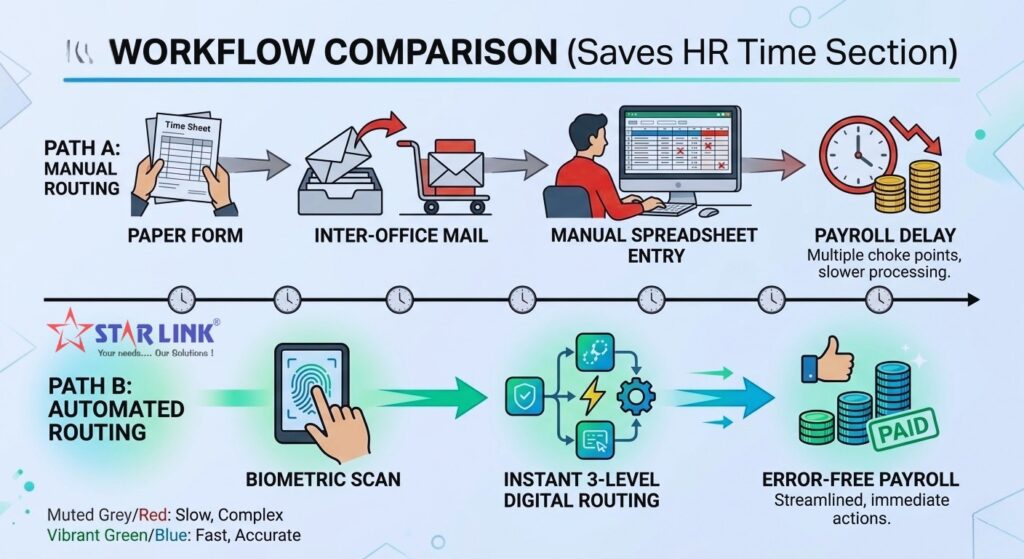
Traditional OT management requires a massive amount of manual coordination, from collecting paper forms to manually updating master spreadsheets. Automation removes these repetitive tasks, shifting HR teams from a reactive administrative stance to a proactive management strategy.
[Manual Form Submission] ➔ [Spreadsheet Logging] ➔ [Email Chasing] (Slow & Errory)
VS.
[Biometric Trigger] ➔ [3-Level Auto-Routing] ➔ [Payroll Ready] (Fast & Precise)
This workflow shift yields faster approval cycles, zero data-entry bottlenecks, and a completely digital, paperless workplace. Better Workforce Planning and Transparency
The software grants localized visibility to HODs and Supervisors, creating total transparency regarding department-wise OT usage and current approval statuses.
Furthermore, overtime data serves as a vital indicator of organizational health. Prolonged extra shifts cause employee fatigue, driving down overall productivity and spiking workplace safety risks. By analyzing structured OT reports, management can pinpoint departments burdened by chronic staffing shortages or shift inefficiencies. This insight helps optimize manpower allocation and determines exactly when additional hiring is required.
Modern businesses operating across multiple branches or plants can manage decentralized operations from a single, centralized console. This is critical for labor-heavy sectors like manufacturing, logistics, healthcare, and security agencies.
Every action taken within the system is digitally timestamped, generating a secure audit trail that details user profiles and historical modifications. This built-in transparency guarantees legal compliance during statutory labor inspections and internal financial audits. Concurrently, employees benefit from a fair, predictable system where they can view their status instantly, boosting workplace satisfaction and retention.
For seamless database handling and rapid report generation, the system runs optimally under these standard parameters:
An automated overtime management system is a strategic financial investment. By curbing unauthorized expenses, ensuring total payroll accuracy, and optimizing shift planning, businesses protect their bottom line while creating a culture of transparency. In a highly competitive economic landscape, replacing legacy paperwork with intelligent automation is an essential step toward sustainable profitability.
