24x7x365 Support No. 011-40848888 (Except National Holidays)



24x7x365 Support No. 011-40848888 (Except National Holidays)
Posted On: October 16, 2026
/Categorized In: Biometric Attendance Machine / Biometric Attendance Software / Biometric Attendance Systems / Biometric Face Reader With Thermal Temperature Screening / Biometric News & Updates / Biometric Security / Biometric Technology at Airport / Biometric Trends / Fingerprint Biometric Devices / HR Management Software
/Written By: Starlink
For Human Resource (HR) leaders and Heads of Operations, tracking attendance and securing entryways directly impact profitability, regulatory compliance, and workplace safety.
Relying on manual registries, legacy card-swipe terminals, or basic proximity tags introduces significant vulnerabilities. These outdated methods expose organizations to data-entry bottlenecks, compliance risks, and costly time-theft practices like “buddy punching.”
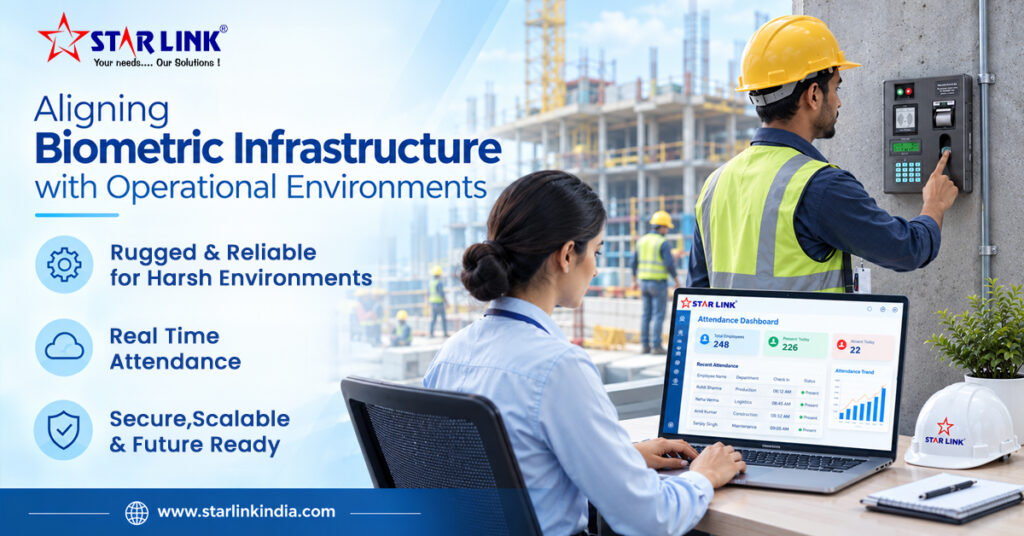
Implementing an effective automated verification framework requires matching the underlying biometric hardware with the specific demands of your physical workspace.
Manufacturing facilities, assembly plants, and fulfillment warehouses present harsh operating conditions. Finely tuned consumer-grade electronics frequently fail in these spaces due to airborne dust, ambient heat, vibration, and fluctuating power grids.
When an attendance terminal fails on a factory floor, it halts shift rotations, frustrates workers, and forces administrators to rely on messy back-calculated estimates. For heavy industrial layouts, enterprise hardware must prioritize rugged durability.
| INDUSTRIAL DEPLOYMENT | Heavy Metallic Body | Shrugs off Dust & Heat | 48-Hour Backup Power | Defeats Local Blackouts | 62,500 Buffer Memory | Eliminates Data Drops |
Corporate headquarters, medical centers, and shared facilities like staff canteens manage large numbers of people moving through distinct choke points during peak morning and evening rushes. In these environments, speed and hygiene are critical priorities.
Moving away from physical contact points streamlines floor traffic while maintaining high standards of workplace cleanliness.
Advanced systems like the Bio Face Reader replace physical fingerprint pads with rapid, contactless visual verification.
| Technical Parameter | Enterprise Specification Standards | Computing Core | Cortex A7 Dual Core (1Ghz Processor Architecture) | Identity Capacity | 10,000 Verified Profiles (Up to 500,000 Total Stored Records) | Spoof Prevention | 3D Structural Feature Extraction (Rejects 2D Photos/Video Screens) | Low-Light Operation | High-Resolution Infrared (IR) Lens paired with active IR LEDs | Network Framework | Real-Time IoT Syncing via TCP/IP, Wi-Fi (WPA2), or GPRS bands |
By measuring facial proportions (such as eyes, cheek alignment, and ear positioning) across a 3D plane, these terminals verify users in less than one second. This approach keeps entry lines moving briskly and ensures that high-resolution printed photos or digital phone screens cannot trick the system.
Mid-sized corporate spaces, multi-tenant commercial buildings, and educational facilities require a balanced approach. They need high log capacities and reliable access control, but prefer low-profile hardware that fits seamlessly into modern office aesthetics.
Classic Model (Weighing) just 600 grams and running on a low-voltage DC 12V system, these units are easy to install on standard drywall or office partitions. Despite their compact size, they include robust hardware relay interfaces. This allows operations managers to connect the terminals directly to turnstiles, magnetic locks, and automated parking barriers, creating a unified access management system.
For emerging small businesses, regional retail branches, and boutique fitness centers, massive enterprise infrastructure is often unnecessary. Managing teams of fewer than 100 people requires a focus on ease of deployment, data portability, and simple administrative workflows.
Compact systems like the Bio Link 09 offer a practical alternative by removing complex IT backend requirements while keeping core tracking features intact.
Operational Efficiency: Streamlined devices bridge the gap for smaller teams by offering a 200,000 log capacity and space for 600 fingerprint templates, delivering reliable performance without unnecessary overhead.
To maximize efficiency, a biometric system must seamlessly convert a physical scan into clean, actionable business data. Modern tracking setups handle this complex process across four automated stages:
1.Biological Capture: Stage 1.
High-resolution 500 dpi optical CMOS sensors or Infrared lenses capture high-definition imagery as an individual approaches the sensor.
2.Mathematical Translation: Stage 2.
The terminal’s dedicated 400MHz DSP processor converts the visual markers into an encrypted algorithmic template (such as a 384-byte fingerprint key or a 4KB facial profile).
3.Rapid Local Verification: Stage 3.
An onboard 32-Bit RISC processor matches the live template against the device’s internal database in under a second, minimizing entry bottlenecks.
4.Centralized Records Update: Stage 4.
The device triggers a green confirmation LED, signals the physical door lock to open, and sends a compact 34-byte data log over TCP/IP or Wi-Fi directly into the central payroll and HR software.
Optimizing your organization’s time-tracking and security systems requires matching hardware capabilities with your specific workplace environment:
Investing in a system tailored to your specific environment helps eliminate payroll calculation errors, protect secure areas, and create a highly accurate, automated operational record.
